'/%3E%3Cpath d='M30 0v30M0 15h60' stroke='%23FFF' stroke-width='10'/%3E%3Cpath d='M30 0v30M0 15h60' stroke='%23C8102E' stroke-width='6'/%3E%3C/svg%3E)
How to Conduct a Workplace Risk Assessment in the UAE (Before the "What If" Becomes Reality)
A UAE guide to workplace risk assessment why OSHAD/Trakhees/KHDA/EIAC approval matters, who needs it, what it covers, how to pick a provider, and why it pays for itself ending with a call to book ABCON.
A UAE guide to workplace risk assessment why OSHAD/Trakhees/KHDA/EIAC approval matters, who needs it, what it covers, how to pick a provider, and why it pays for itself ending with a call to book ABCON.
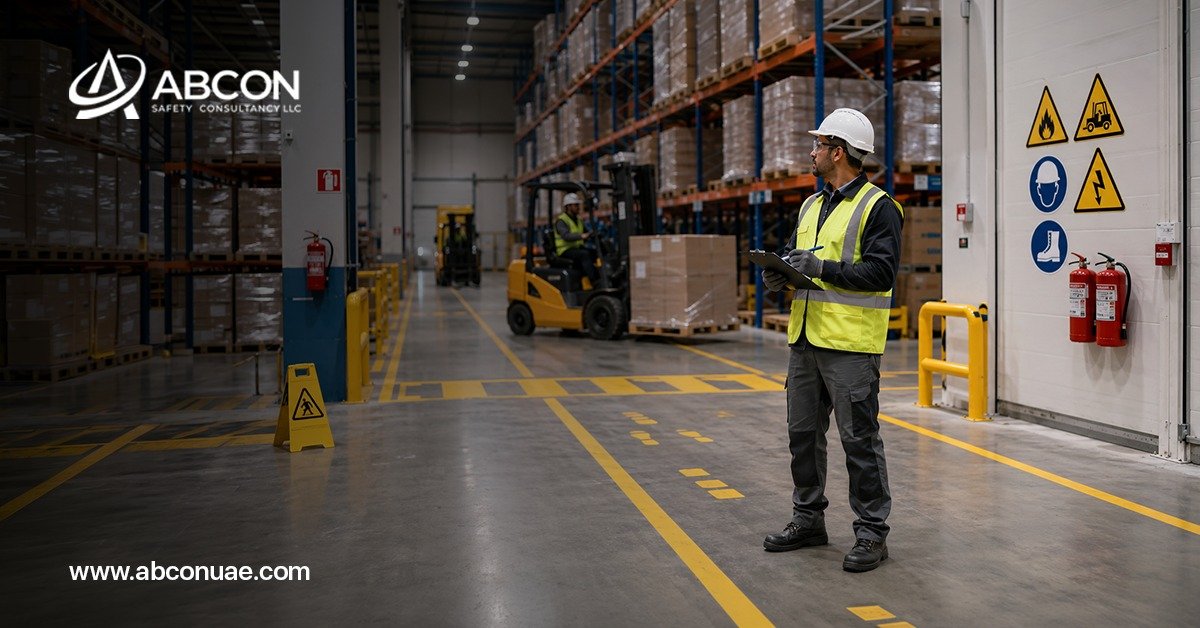
Picture this: it's 7:45am on a Sunday, the start of the working week. A warehouse supervisor in Jebel Ali is walking the floor before the shift begins. A forklift operator waves hello, a new hire is stacking pallets a little too close to a blocked fire exit, and a maintenance technician is up on a ladder near an exposed electrical panel that's been "on the list to fix" for three weeks. Nothing has gone wrong yet. But every one of those small, ordinary moments is a risk sitting quietly in plain sight, waiting for the one unlucky combination of circumstances that turns a normal Sunday into an incident report, an insurance claim, or worse.
This is exactly why workplace risk assessment exists not as a compliance checkbox, but as the habit of spotting the ladder, the blocked exit, and the panel before they become the headline. And in the UAE, doing it properly isn't optional. It's regulated, audited, and increasingly non-negotiable for companies that want to keep operating, keep their licenses, and keep their people safe.
Why Regulatory Approval Actually Matters Here
The UAE has built one of the region's most structured occupational health and safety ecosystems, and it varies by emirate and jurisdiction — which trips up a lot of companies operating across multiple locations.
In Abu Dhabi, the Abu Dhabi Occupational Safety and Health Center (OSHAD) sets the framework that virtually every sector must follow, from construction to healthcare to oil and gas. In Dubai's free zones tied to ports, customs, and logistics, Trakhees enforces its own HSE code, and getting it wrong can mean a stalled operation, not just a fine. Training providers delivering safety courses in Dubai typically need approval from the Knowledge and Human Development Authority (KHDA), which licenses the institutes themselves, while bodies like the Emirates International Accreditation Centre (EIAC) accredit certification schemes to international standards so that a qualification actually holds weight with auditors, insurers, and clients — not just a certificate on a wall.
Why does this matter to you as a business owner or HSE manager? Because a risk assessment conducted by an unaccredited provider, or training delivered by an institute without the right approvals, can leave you exposed in three ways: it may not satisfy your regulator during an audit, it may not be recognized by your insurer if a claim arises, and it may simply be wrong built on generic templates rather than UAE-specific hazard categories and legal thresholds. Approval isn't bureaucracy for its own sake. It's the difference between a document that protects you and one that just looks like it does.
Who Actually Needs This?
Risk assessment isn't just a "construction site" thing. It's relevant across a surprising range of industries operating in the UAE, including:
Construction and infrastructure — high-frequency, high-severity hazards from heights, heavy machinery, and excavation
Oil, gas, and energy — confined spaces, flammable materials, and process safety risks
Manufacturing and industrial facilities — machinery guarding, chemical handling, noise exposure
Logistics, warehousing, and ports — forklift operations, manual handling, working at height
Hospitality and facilities management — kitchen hazards, fire safety, guest and staff safety
Healthcare and laboratories — biological hazards, sharps, chemical exposure
Retail and commercial real estate — crowd management, fire evacuation, electrical safety
Education and training institutions — child and staff safety, emergency preparedness
Events and entertainment — temporary structures, crowd control, electrical rigging
If your business has people, equipment, and a physical space where things can go wrong, it needs a risk assessment strategy — full stop.
The Types of Courses and Services on Offer
Not every organization needs the same level of intervention, and a good consultancy should offer a range of entry points:
Risk assessment training courses — equipping your internal HSE team or supervisors to conduct assessments themselves, on an ongoing basis, rather than relying solely on external consultants.
On-site risk assessment audits — a consultancy team physically walks your facility, identifies hazards, and produces a formal risk register and action plan.
Sector-specific risk assessment programs — tailored modules for construction, oil and gas, healthcare, or hospitality, addressing the hazards unique to each.
HSE management system development — building risk assessment into a broader, documented safety management framework aligned with OSHAD or Trakhees requirements.
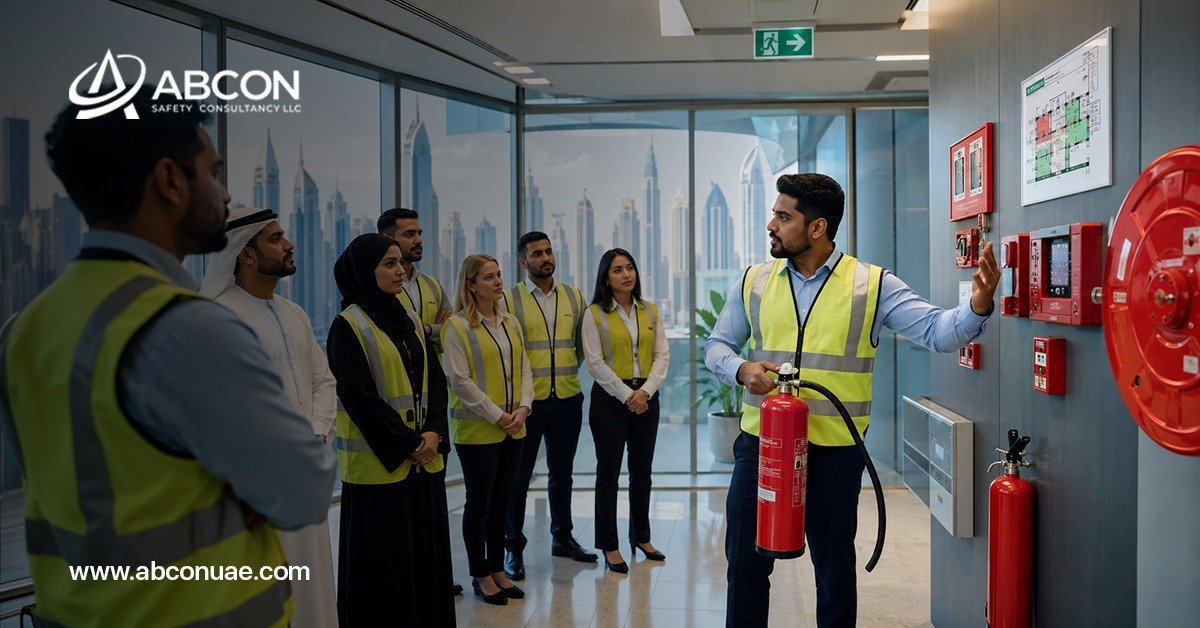
Emergency response and fire risk assessment — focused specifically on evacuation planning, fire load assessment, and emergency preparedness.
Refresher and ongoing compliance training — because regulations update, staff turnover happens, and a one-time assessment goes stale fast.
What's Actually Covered in a Proper Assessment
A genuinely thorough workplace risk assessment goes well beyond a walkthrough with a clipboard. It should include:
Hazard identification across physical, chemical, biological, ergonomic, and psychosocial categories
Risk rating methodology — scoring likelihood and severity to prioritize what gets fixed first
Legal and regulatory benchmarking against OSHAD, Trakhees, or the relevant local framework
Control measure hierarchy — elimination, substitution, engineering controls, administrative controls, and PPE, applied in the correct order
Emergency and evacuation planning, including fire risk and muster point adequacy
Manual handling and ergonomic assessment for roles involving repetitive strain or lifting
Machinery and equipment safety checks, including guarding and lockout/tagout procedures
Documentation and risk register creation that stands up to audit
Staff competency and training gap analysis — because a control measure only works if people know how to use it
Review and revision scheduling, since a risk assessment is a living document, not a one-time exercise
How to Choose the Right Provider
With safety consultancies proliferating across the UAE, picking the right one comes down to five things:
Regulatory accreditation — confirm the provider is approved by the relevant body (KHDA, OSHAD, EIAC, Trakhees) for your emirate and sector.
Sector-specific experience — a consultancy that's assessed ten warehouses will spot things a generalist won't.
Practical, on-site delivery — favor providers who walk your actual facility over those offering only desk-based, templated reports.
Ongoing support, not just a one-off report — the best providers help you build internal capability and revisit assessments periodically.
Transparent, auditable documentation — you should receive a risk register and action plan you can hand directly to an auditor or insurer, not a vague summary.
Why This Is an Investment, Not an Expense
It's tempting to view risk assessment as a cost center time, fees, and paperwork that don't show up on a balance sheet. But the numbers tell a different story. The International Labour Organization estimates that work-related injuries and illnesses cost the global economy the equivalent of roughly 4% of GDP annually through lost workdays, compensation, and reduced productivity. In the UAE specifically, regulators have steadily tightened enforcement, and non-compliance findings during OSHAD or Trakhees audits can result in operational suspensions — a far more expensive outcome than the cost of proactive assessment.
There's also the quieter cost: insurance premiums that climb after an incident, tender bids lost because a client's due diligence flags weak HSE documentation, and the very real toll on morale and retention when staff don't feel safe. A solid risk assessment program, by contrast, tends to pay for itself in fewer disruptions, smoother audits, better insurance terms, and a workforce that trusts its employer to have its back.
Let's Walk Your Site Before It Walks Itself Into a Problem
At ABCON Safety Consultancy LLC, we help businesses across the UAE turn "what if" into "we've got this" with regulatory-approved risk assessment training, on-site audits, and HSE program development tailored to your sector and your emirate. Whether you need your team trained, your facility assessed, or your entire safety management system rebuilt from the ground up, our consultants bring the accreditation and the on-the-ground experience to get it right the first time.
Get in touch with ABCON Safety Consultancy LLC today to schedule a site consultation or enroll your team in our next risk assessment training course — because the best emergency is the one that never happens.