'/%3E%3Cpath d='M30 0v30M0 15h60' stroke='%23FFF' stroke-width='10'/%3E%3Cpath d='M30 0v30M0 15h60' stroke='%23C8102E' stroke-width='6'/%3E%3C/svg%3E)
What Makes a Leading Safety Consultancy in Dubai?
A friendly guide answering "what makes a safety consultancy in Dubai the best choice?" covering the certifications, services, and experience to look for, then showing how ABCON checks those boxes, ending with a quick FAQ and a call to book a consultation.
A friendly guide answering "what makes a safety consultancy in Dubai the best choice?" covering the certifications, services, and experience to look for, then showing how ABCON checks those boxes, ending with a quick FAQ and a call to book a consultation.
Dubai's construction, marine, logistics, and industrial sectors operate under some of the strictest and most fragmented safety regulatory frameworks in the region. Between Dubai Municipality, Dubai Civil Defence (DCD), DCAS, Trakhees, and EIAC accreditation requirements, choosing the wrong safety partner can mean failed inspections, delayed projects, or non-compliance penalties.
A leading safety consultancy in Dubai is defined by five things: government-recognized accreditations, breadth of inspection and training services, hands-on regulatory experience, fast turnaround on certifications, and a verifiable track record across multiple industries. Below is what to actually look for and why it matters.
1. Government and International Accreditation
This is the single biggest differentiator between a genuine safety consultancy and a company that simply offers general HSE advice. In Dubai specifically, the accreditations that carry real regulatory weight include:
DCAS (Dubai Civil Defence Approved) — required for fire and life safety-related training and certification
Trakhees — mandatory for any work carried out within Trakhees-governed zones (Palm Jumeirah, Dubai Maritime City, ports, and free zones under Dubai World)
Dubai South — required for operations within the Dubai South free zone and Al Maktoum International Airport-linked developments
EIAC (Emirates International Accreditation Centre) — the UAE's national accreditation body for inspection bodies operating to ISO/IEC 17020
If a consultancy cannot show current, verifiable accreditation numbers for the specific zone you operate in, their certificates may not be accepted during a government or client audit regardless of how the company markets itself.
2. Breadth of Inspection Services
A consultancy limited to one or two inspection types (for example, only fire extinguishers or only lifting gear) isn't equipped to be a long-term compliance partner. Look for coverage across:
Lifting equipment, lifting accessories, and loose gear
Pressure vessels and storage tanks
Scaffolding and work-at-height systems
Non-destructive testing (NDT — MPI, UT, PT)
Electrical integrity, thermography, and earthing systems
Marine and offshore inspections (bollard pull tests, mooring winch testing, spooling operations)
Companies offering this full range typically service construction, marine, oil & gas, logistics, and facilities management clients from a single point of contact which reduces vendor management overhead considerably.
3. Depth of HSE Training Programs
Inspection and training should come from the same provider wherever possible, since a consultancy that trains your team also understands the practical risk profile of your site. Core programs to expect:
HSE induction and awareness training
First Aid and CPR/AED certification
Fire fighting and emergency response training
Work-at-height and confined space training
Risk assessment and incident investigation training
KHDA and ACTVET approval (for corporate and vocational training respectively) are the relevant local benchmarks here, alongside internationally recognized bodies like Highfield, HSI, and Medic First Aid.
4. Regulatory Experience Across Emirates
Dubai doesn't operate in isolation many clients need consistent compliance support across Abu Dhabi, Sharjah, and the Northern Emirates too. A consultancy with proven multi-emirate experience (rather than a single-city operation) is generally better positioned to handle companies with operations spanning the UAE, since regulatory requirements shift meaningfully between OSHAD (Abu Dhabi), Dubai Municipality, and free zone authorities.
5. Turnaround Time and Track Record
Practically speaking, the two things that matter most on a live project:
How fast can they inspect, certify, and issue reports? Delays here directly delay project handover and payment milestones.
How many projects and professionals have they actually certified? Ask for numbers years active, clients served, and professionals trained are reasonable, verifiable benchmarks any established consultancy should share openly.
How ABCON Safety Consultancy Meets These Standards
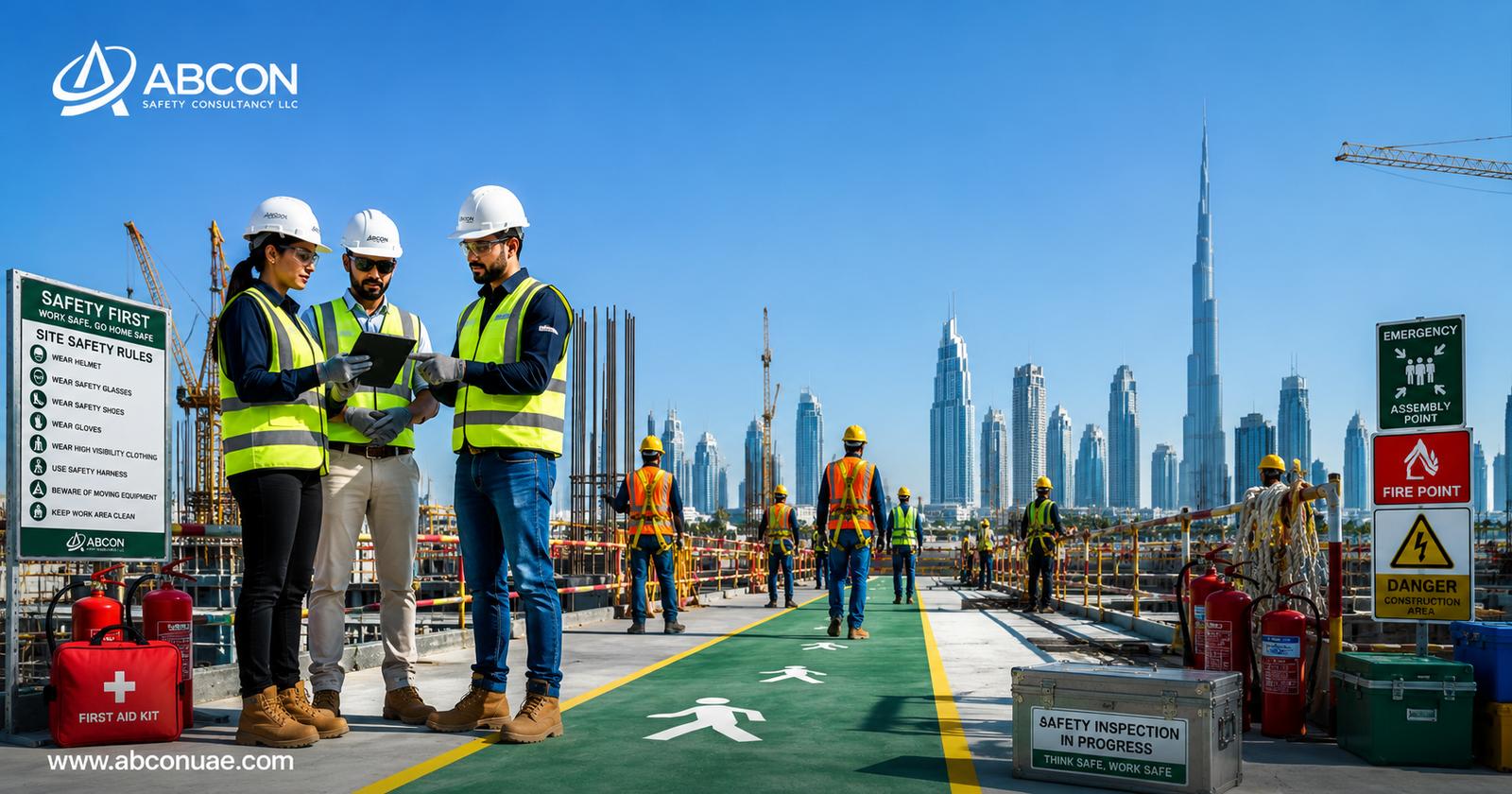
ABCON Safety Consultancy has operated across the UAE for 10+ years, holding accreditation across EIAC, KHDA, DCAS, ACTVET, ENAS, ADM, Trakhees, Dubai South, and LEEA covering both the inspection and training sides of compliance under one provider. With 500+ projects completed and 15,000+ professionals trained, our teams handle everything from lifting equipment and pressure vessel inspections to marine certifications and fire/first aid training, with coverage across Dubai and all seven emirates.
Frequently Asked Questions
What is a leading safety consultancy in Dubai?
A leading safety consultancy in Dubai is a firm holding recognized government accreditations (such as DCAS, Trakhees, and EIAC) that provides both third-party inspection and HSE training services, with a verifiable track record across multiple industries and emirates.
What accreditations should a Dubai safety consultancy hold?
At minimum: EIAC for inspection body accreditation, DCAS for Civil Defence-related fire/life safety work, KHDA for training approval, and Trakhees or Dubai South approval if operating within those specific free zones.
How do I verify a safety consultancy's accreditation in Dubai?
Ask for their current accreditation certificate numbers and cross-check them against the relevant authority's public registry (EIAC, DCAS, KHDA, or Trakhees all maintain approved-provider listings).
Does a safety consultancy in Dubai also need to cover other emirates?
Not always, but consultancies with multi-emirate coverage are generally better suited to companies with projects or offices outside Dubai, since compliance requirements vary by emirate (e.g., OSHAD in Abu Dhabi vs. Dubai Municipality in Dubai).