'/%3E%3Cpath d='M30 0v30M0 15h60' stroke='%23FFF' stroke-width='10'/%3E%3Cpath d='M30 0v30M0 15h60' stroke='%23C8102E' stroke-width='6'/%3E%3C/svg%3E)
Choosing a First Aid Training Center in Abu Dhabi: Course Content, Approvals and Certification
This guide helps businesses choose a first aid training center in Abu Dhabi by explaining what a good course covers, which approvals to verify (including client-specific requirements for ADNOC-linked work), and how certification and renewals work.
This guide helps businesses choose a first aid training center in Abu Dhabi by explaining what a good course covers, which approvals to verify (including client-specific requirements for ADNOC-linked work), and how certification and renewals work.
Choosing a first aid training center is a safety decision and a compliance decision. A good course prepares your team to act in the first few minutes of an emergency. A good certificate is accepted by your client, your auditor and your site.
If you are looking for an ADNOC approved first aid training center in Abu Dhabi, this guide explains what a course should cover, which approvals to check, and how certification works, so you can compare providers with confidence.
Why the Choice Matters
Industrial, construction and oil and gas sites in Abu Dhabi involve heavy equipment, heat, work at height and sometimes remote locations. When an incident happens, the nearest trained person often decides the outcome. That is why clients expect trained first aiders on site, and not only certificates in a file.
A training center should help you pass two tests:
The competence test: Can your people respond correctly under pressure?
The documentation test: Will your client, auditor or insurer accept the certificate?
A course that passes only one of these leaves you exposed.
Part 1: Course Content
What a Good Workplace First Aid Course Covers
A strong one-day workplace course should include the following.
Scene safety and patient assessment. Before helping, a responder must check the area is safe, call for help, and check whether the person responds and is breathing. This sounds simple, but it is hard to do calmly when someone is hurt, so it needs practice.
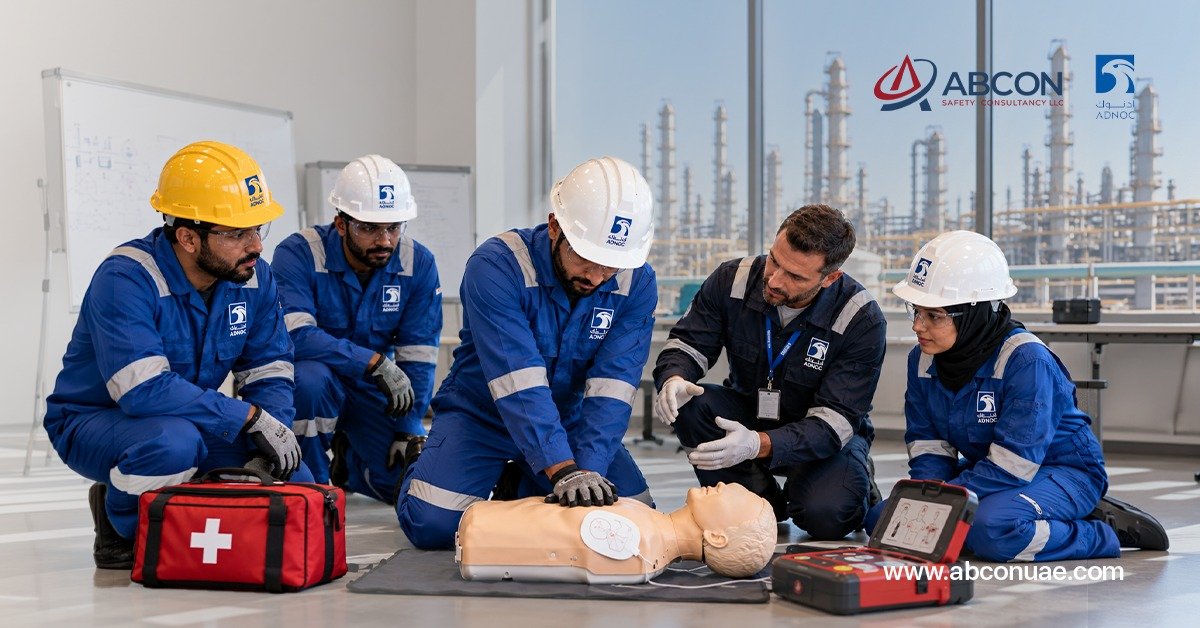
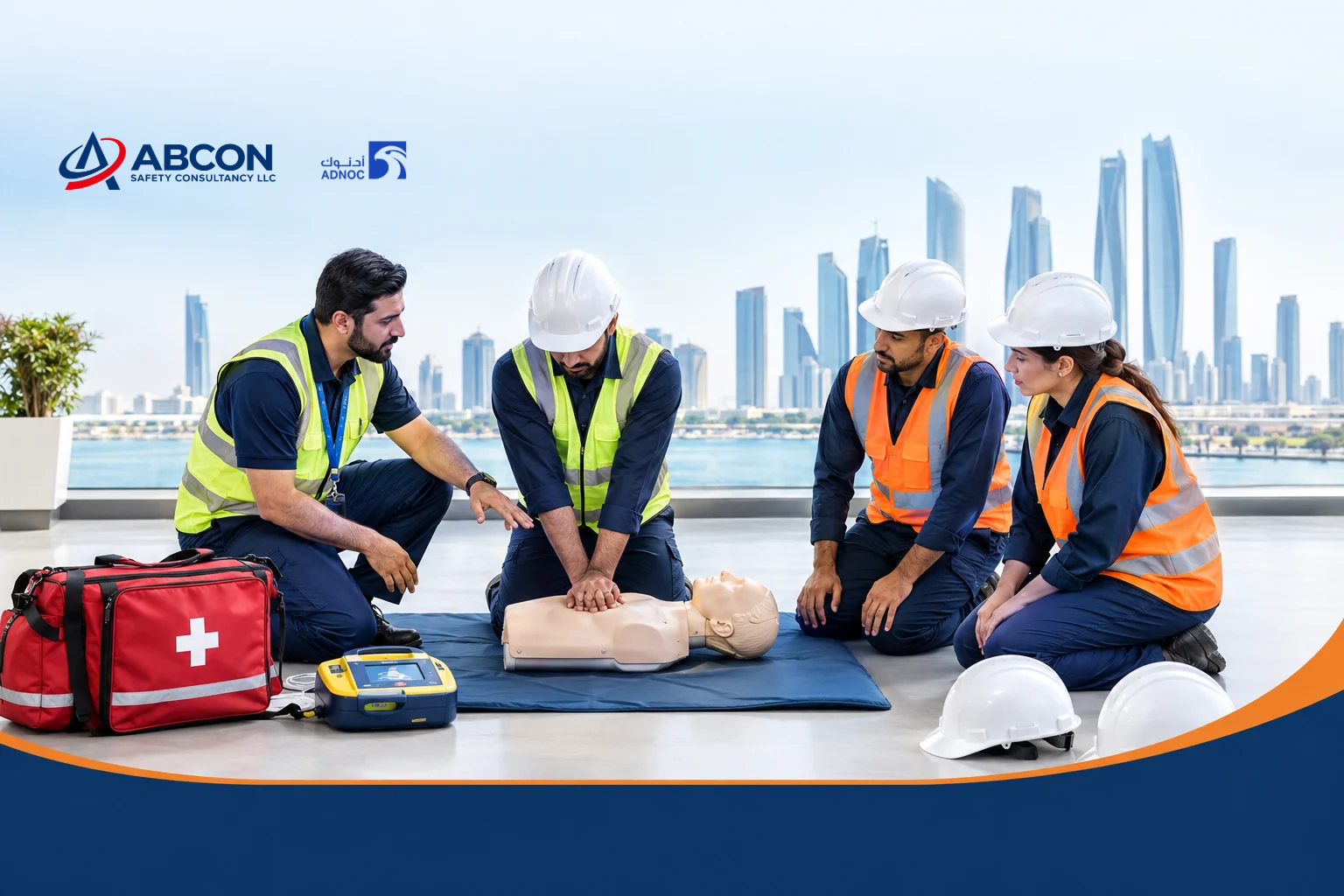
CPR and AED use. Participants practise on training mannequins: hand position, compression depth, steady rhythm and using an AED by placing the pads and following its prompts. The trainer corrects technique on the spot.
Treating common workplace injuries. The course should cover:
Burns
Fractures
Choking
Severe bleeding
Shock
Scenario practice. Realistic situations, such as a worker found collapsed near equipment, test whether people can take charge and treat in the right order.
A practical assessment. The course should check what people can do, not only that they attended.
You can see how ABCON structures its one-day course on our First Aid Training page.
Signs of Quality Content
What to look for | Why it matters |
|---|---|
Most of the day is hands-on | Practice builds real skill, slides do not |
Small groups | Everyone gets time on the mannequin and gets corrected |
Trainers with field experience | They can answer “what if this happens on my site?” |
Scenarios that match your sector | Industrial sites differ from offices |
Practical test at the end | Confirms real competence |
Trainees often tell us the most useful part is learning exactly what to follow on site and why, rather than memorising lists. That is a good sign that a course connects to real work.
Questions About Content to Ask Any Provider
What share of the day is practical?
How many people are in each group?
Which scenarios will you use for our type of site?
Who are the trainers, and what is their experience?
For an independent benchmark on first aid protocols, you can compare any course outline against the Red Cross first aid guidance.
Part 2: Approvals
What “Approved” Really Means
The word “approved” is used loosely. Before you compare providers, ask three questions:
Who gives the approval? A government body, a regulator, a client, or an international certifying organisation?
What does it cover? First aid training specifically, or something else?
Is it current? Approvals have validity dates.
ABCON’s first aid course is Medic First Aid certified, DCAS approved and ACTVET accredited and ADNOC approved
ADNOC Requirements Depend on the Project
ADNOC requirements apply to ADNOC projects and sites, and individual contracts can add their own conditions. A certificate that satisfies one client may not satisfy another. The reliable sources are your contract, your client’s HSE team and ADNOC’s official website.
Abu Dhabi and Dubai are also separate emirates with separate authorities, so do not assume one approval covers both. If your team works in both, confirm what applies at each site.
How to Check an Approval
When a provider shows you an approval document, check:
Scope: Does it cover first aid training?
Dates: Is it valid today, and when does it expire?
Fit: Does it match what your client asks for?
A trustworthy provider is happy to be checked, and will tell you plainly if a certificate does not cover your project. Be careful with any provider that says its certificate is “accepted everywhere” without asking about your project.
Part 3: Certification
What You Should Receive
After a course, you should get a certificate for each participant that clearly shows:
The participant’s name
The course name and date
The training provider
The validity or expiry date
A way for a third party to verify it
Questions About Certification to Ask Before Booking
When will certificates be issued, and in what format?
Can a client or auditor verify them?
How long are they valid?
What is the refresher plan?
What happens if our client questions a certificate?
First aid skills fade, and certificates expire. A provider that explains the renewal process upfront is thinking about your long-term compliance, not just today’s booking.
Keeping Your Records in Order
Many companies lose time because certificates are scattered. A simple system helps:
Keep one register of every first aider, their certificate and expiry date
Set reminders at least a month before expiry
Train a few extra people to cover leave and staff changes
Make sure every shift has a trained first aider
Review the plan after any incident or near miss
A Simple Checklist for Choosing a Center
Check | Question to ask |
|---|---|
Approvals | Can I see the documents, scope and dates? |
Project fit | Will the certificate be accepted on my project? |
Practical content | How much of the day is hands-on? |
Trainers | What is their field experience? |
Group size | How many people per trainer? |
Certification | Who can verify it, and when does it expire? |
Delivery | Can you train at our site or across shifts? |
Support | What help do we get after the course? |
Common Mistakes to Avoid
Choosing by price alone. Check group size, what is included and whether certificates can be verified.
Assuming one certificate fits every project. Always confirm with your client.
Picking a theory-heavy course. Slides produce certificates, practice produces responders.
Letting certificates expire. A missed renewal can delay your team starting work.
Not asking for documents. Claims are not proof.
Planning Training for Your Team
Abu Dhabi projects often involve shifts and remote sites. When you plan training, consider whether on-site delivery would save travel time, whether sessions can be split across shifts, and whether the provider can handle groups of different sizes. Flexible delivery makes it easier to keep every shift covered.
Related Reading
If you want to understand wider compliance, our blog has practical guides on training, inspection and accreditation. If your sites use loaders or lifting equipment, our inspection services explain how periodic inspection works.
Train With ABCON
ABCON delivers a practical one-day first aid course for teams in Abu Dhabi and across the UAE. It covers CPR, AED use, emergency patient assessment, and the treatment of burns, fractures, choking, bleeding and shock. We welcome questions about our approvals, and we encourage you to confirm your client’s requirements before booking.
To see the full course details, visit our First Aid Training page