'/%3E%3Cpath d='M30 0v30M0 15h60' stroke='%23FFF' stroke-width='10'/%3E%3Cpath d='M30 0v30M0 15h60' stroke='%23C8102E' stroke-width='6'/%3E%3C/svg%3E)
Dock Leveler Inspection UAE: Preventing Warehouse Loading Accidents
Dock levelers are small but safety-critical, and failures cause forklift tip-offs, falls, trailer creep and maintenance crush injuries. The blog explains what a nine-point inspection covers, notes that no UAE-specific standard exists, and suggests daily checks, manufacturer-based maintenance and an annual documented inspection. It also lists red flags for taking a leveler out of service.
Dock levelers are small but safety-critical, and failures cause forklift tip-offs, falls, trailer creep and maintenance crush injuries. The blog explains what a nine-point inspection covers, notes that no UAE-specific standard exists, and suggests daily checks, manufacturer-based maintenance and an annual documented inspection. It also lists red flags for taking a leveler out of service.
Introduction
The loading dock is where a warehouse is most exposed. Forklifts, pallets, pedestrians, and trucks all meet in a few square metres, and the dock leveler is the only thing bridging the gap between the building and the trailer.
When it works, nobody notices it. When it fails, a forklift can tip off the edge, a worker can fall into the pit, or a trailer can leave while someone is still driving across. Most of these incidents are preventable with a structured dock leveler inspection, and this guide explains what to check, how often, and what to do when something is wrong.
What Is a Dock Leveler?
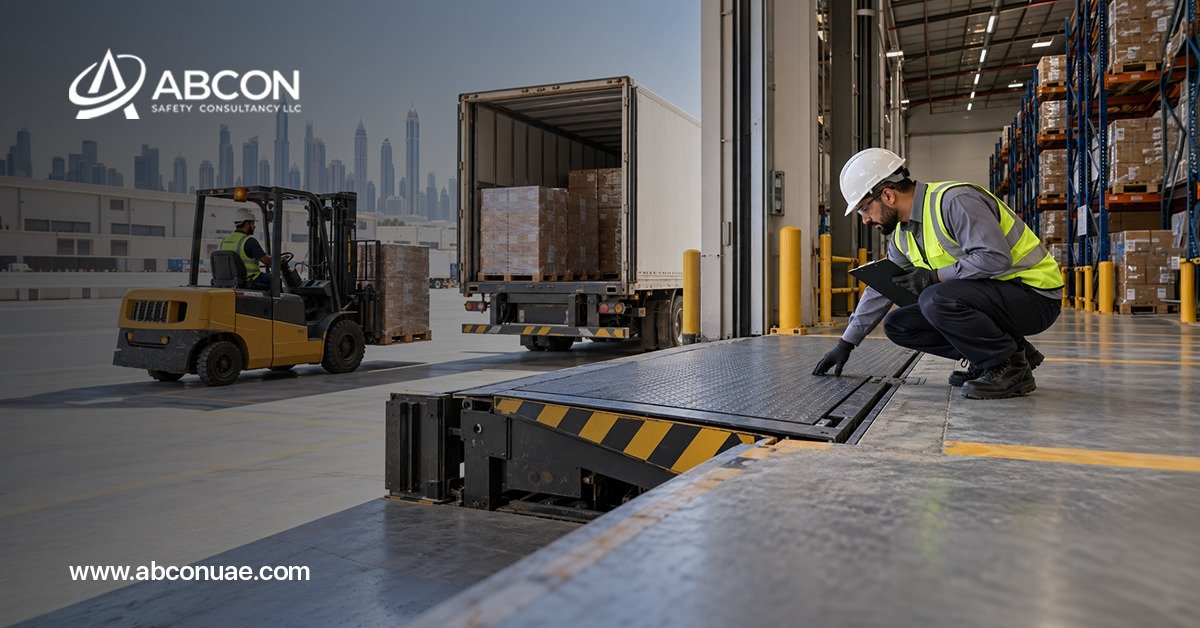
A dock leveler is a platform built into the loading bay that adjusts to the height of a truck or trailer bed so forklifts and pallet trucks can move loads safely between the warehouse and the vehicle. Common types include mechanical, hydraulic, and air-powered levelers, along with edge-of-dock levelers and portable dock plates.
Because they carry heavy, moving loads over a gap with a vertical drop, they are safety-critical equipment, even though they rarely appear on a standard inspection register.
Why Loading Dock Accidents Happen
Published loading dock safety guidance repeatedly points to the same hazards:
Forklift tip-off or drop-off when a leveler creeps, drops, or fails to hold position
Falls from dock edges or through gaps between the leveler and the trailer
Trailer creep or early departure, where a truck moves while a forklift is on the leveler
Crush injuries during maintenance, when a raised leveler is not locked out with its maintenance strut
Slips on hydraulic oil, water, or debris on the dock floor or in the pit
Electrical hazards from damaged control panels and wiring
A university EHS guide on loading dock safety lists collisions with forklifts, falls from unprotected dock edges, slippery surfaces, and missing guardrails among the most common dock hazards. You can read the University of California, Irvine loading dock safety reference guide for the full list.
Why Dock Levelers Need Extra Attention in the UAE
UAE warehouses and logistics hubs face operating conditions that accelerate wear:
Heat can degrade hydraulic seals and hoses, and affect fluid performance
Dust and sand collect in the dock pit, hinges, and lip mechanism, causing sticking or uneven movement
High-volume operations mean levelers cycle many times a day, increasing wear on hinges, lips, and hydraulics
Mixed fleets of trucks and trailers with varying bed heights place different loads on the leveler
These are operating realities rather than regulations, but they make a routine inspection programme more valuable.
What Standards and Rules Apply?
It is worth being clear here. We are not aware of a dedicated UAE standard written specifically for dock levelers. In practice, they fall under the general employer duty to maintain safe equipment and workplaces under UAE occupational safety requirements, plus the expectations of your client, insurer, and auditors.
Many facilities use the manufacturer's manual as the primary reference and benchmark against international standards such as ANSI/MHI MH30.1, which covers the performance and testing requirements for dock leveling devices. Related standards cover portable dock plates and vehicle restraining devices. The Material Handling Industry (MHI) publishes the MH30 series.
Always check what your site authority, client, or insurer requires, because some will ask for documented inspection of dock equipment as part of a wider lifting or warehouse equipment audit.
What a Dock Leveler Inspection Covers
A thorough inspection should include:
Deck and structure: cracks, bends, holes, worn anti-skid surface, and damage to the frame
Lip and hinge mechanism: smooth extension and retraction, lip engagement, hinge wear, and any sticking
Operating system: hydraulic cylinders, hoses, and pump for leaks, or mechanical springs and linkages for wear and correct tension
Safety devices: maintenance strut or lock-out leg, toe guards, and any velocity fuse or anti-drop device
Controls and electrical: control panel, push buttons, wiring, and emergency stop functions
Dock pit: debris, standing water, drainage, and condition of the pit walls and floor
Capacity and labelling: posted rated capacity, warning labels, and legible markings
Vehicle restraints and signals: restraint operation and red/green communication lights, where fitted
Surroundings: dock edge protection, floor markings, lighting, and housekeeping
If the leveler is part of a wider lifting equipment programme, our guide on lifting equipment inspection in the UAE explains how formal inspection and certification fit together.
How Often Should Dock Levelers Be Inspected?
There is no single fixed interval that applies everywhere, so frequency should follow the manufacturer's instructions, your risk assessment, and client or insurer requirements. The following is practical good-practice guidance:
Check | Typical frequency |
|---|---|
Operator pre-use visual check | Every shift or daily |
Planned preventive maintenance by a competent technician | Per manufacturer, often quarterly to six-monthly |
Formal documented inspection by a competent person | At least annually |
After repair, impact, or unusual operation | Immediately, before return to service |
High-volume or harsh environments | More frequently |
Keep a log for each leveler so you can show an auditor when it was inspected, what was found, and what was done.
Red Flags: When to Take a Leveler Out of Service
Stop using the leveler, tag it out, and arrange repair if you see:
A leveler that creeps down or fails to hold position under load
Cracks, bent sections, or holes in the deck
Hydraulic fluid leaks on or around the unit
A lip that does not extend, retract, or engage properly
A missing or damaged maintenance strut
Damaged wiring or control panels
Illegible or missing capacity labels
Using a faulty leveler "until the next shift" is how most dock incidents begin.
Safe Maintenance: A Critical Point
Crush injuries during maintenance are among the most serious dock leveler risks. Manufacturer safety labels commonly instruct technicians to store the leveler in the vertical position with the lip extended, engage the lock-out pin on the maintenance strut, and not stand in front of the leveler when removing it. Only trained, competent personnel should carry out maintenance and inspection, following the manufacturer's procedures.
Who Should Inspect Dock Levelers?
Daily checks can be done by trained dock operators and supervisors. Formal inspections and maintenance should be done by a competent person with knowledge of the specific equipment, such as a manufacturer-trained technician or an independent inspection provider. Independent inspection adds an unbiased record, which is useful for client and insurer audits.
ABCON's inspection services cover a wide range of industrial and warehouse equipment, including non-mandatory inspections that many clients and insurers request. If forklifts and lifting equipment also operate at your dock, see our guide on why third-party lifting equipment inspection is mandatory in the UAE.
Best Practices Checklist
Register every dock leveler and give it a unique ID
Follow the manufacturer's manual and maintenance schedule
Train operators to do a pre-use check and report faults immediately
Use wheel chocks or vehicle restraints and clear red/green signalling
Lock out and tag out levelers during maintenance
Keep dock pits clean, dry, and free of debris
Post rated capacity and keep labels legible
Schedule a documented annual inspection by a competent person
Keep an inspection and repair log for audits
Frequently Asked Questions
1. Is dock leveler inspection mandatory in the UAE?
We are not aware of a dedicated UAE regulation specific to dock levelers. They fall under the general duty to maintain safe equipment, and clients, insurers, and auditors often expect documented inspection. Check the requirements for your site.
2. How often should a dock leveler be inspected?
Operators should check it daily or every shift, preventive maintenance should follow the manufacturer's schedule, and a formal documented inspection is good practice at least annually.
3. What is the most common dock leveler fault?
Hydraulic leaks, worn lips and hinges, and levelers that creep or fail to hold position are common problems, often made worse by dust and heavy use.
4. Can I keep using a leveler with a small hydraulic leak?
No. A leak is both a slip hazard and an early warning of a failing system. Tag it out and have it repaired before further use.
5. Who is qualified to inspect dock levelers?
A competent person with knowledge of the specific equipment, such as a manufacturer-trained technician or an independent inspection provider.
Final Thoughts: Inspect the Gap Before It Becomes an Accident
A dock leveler is a small piece of equipment with large consequences. A simple routine of daily checks, planned maintenance, and a documented annual inspection can prevent the incidents that cause serious injuries and expensive downtime.
Need your dock levelers and loading bay equipment inspected? Contact ABCON Safety Consultancy to discuss an inspection scope for your warehouse and keep your loading operations safe.