'/%3E%3Cpath d='M30 0v30M0 15h60' stroke='%23FFF' stroke-width='10'/%3E%3Cpath d='M30 0v30M0 15h60' stroke='%23C8102E' stroke-width='6'/%3E%3C/svg%3E)
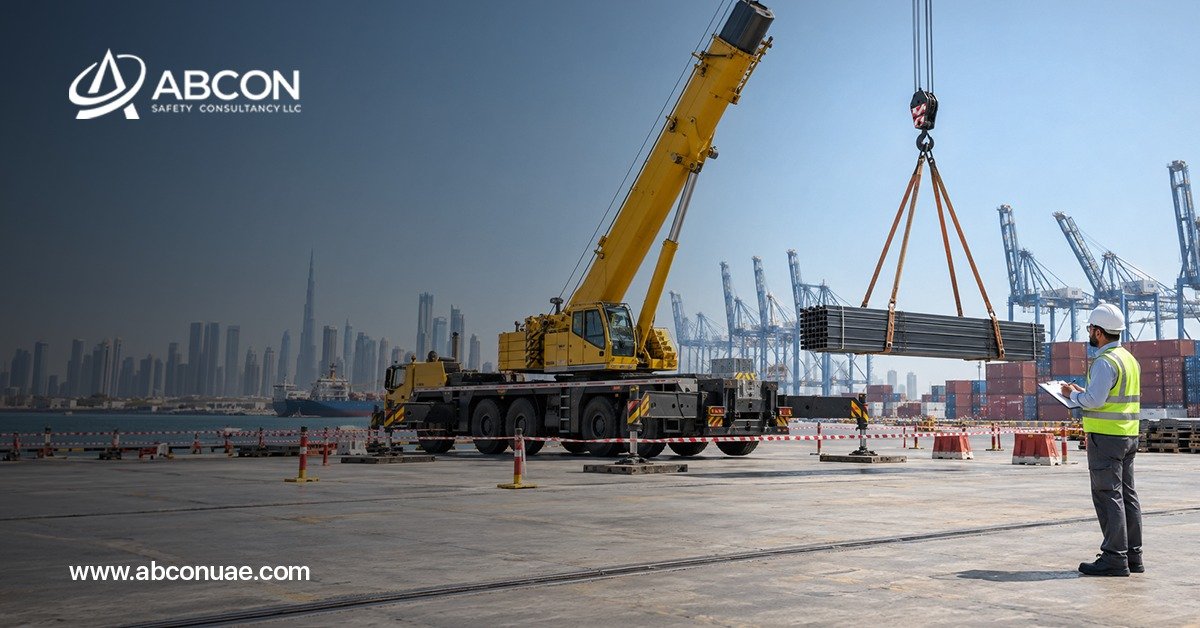
Crane & Lifting Equipment Certification in the UAE: LEEA Standards Explained
Explains LEEA (Lifting Equipment Engineers Association) standards for crane/lifting equipment certification — what they cover, how LEEA differs from UK's LOLER regulations, the training pathway (Foundation → LEG/LMM/LMP/OTC), and how to verify a provider's credentials before hiring.
Explains LEEA (Lifting Equipment Engineers Association) standards for crane/lifting equipment certification — what they cover, how LEEA differs from UK's LOLER regulations, the training pathway (Foundation → LEG/LMM/LMP/OTC), and how to verify a provider's credentials before hiring.
Introduction
Anyone sourcing crane inspection or lifting equipment certification services in the UAE runs into the same acronym repeatedly: LEEA. It appears on inspection reports, training certificates, and provider credentials across the industry but many facility managers and project owners aren't entirely clear on what LEEA actually is, what its standards cover, or why it matters more than a generic "certified inspection" claim.
This guide breaks down what LEEA standards actually mean for crane and lifting equipment certification in the UAE, how they differ from other frameworks you may have heard of, and what to look for when choosing a provider whose LEEA credentials are genuine and relevant to your equipment.
What Is LEEA?
The Lifting Equipment Engineers Association (LEEA) is a global trade association representing organizations across the design, manufacture, inspection, maintenance, and hire of lifting equipment. Originally founded in 1944 as the Chain Testers Association of Great Britain, the organization adopted its current name in 1988 to better reflect its modern scope, and today represents well over a thousand member organizations operating across more than 80 countries, including a substantial and active presence in the UAE.
LEEA isn't a UAE-specific regulatory body — it's an internationally recognized technical authority whose standards and training programs are adopted voluntarily by companies seeking to demonstrate a genuine, audited level of competency in lifting equipment work, above and beyond baseline local compliance.
What Do LEEA Standards Actually Cover?
LEEA's technical requirements, published in its core reference document (LEEA 042) along with supporting guidance notes, set demanding standards across four key areas:
1. Equipment Standards
Covering the design, manufacture, and thorough examination requirements for cranes, hoists, lifting gear, slings, and rigging accessories — establishing what "properly inspected" actually means in technical, auditable terms.
2. Personnel Competency
LEEA-accredited training programs certify individuals — inspectors, appointed persons, and lifting engineers against demonstrated technical knowledge, not just course attendance.
3. Procedural Standards
Setting out how thorough examinations, testing, and re-certification should be conducted and documented, ensuring consistency regardless of which LEEA member organization performs the work.
4. Ongoing Compliance Auditing
LEEA member organizations are subject to regular compliance audits by LEEA itself membership isn't a one-time credential, and companies can lose their status if they fail to maintain the required standards over time.
This combination equipment standards, personnel competency, procedural consistency, and ongoing auditing is what separates a LEEA-certified inspection from a generic "we checked it" service.
LEEA Training Pathways Relevant to UAE Lifting Professionals
LEEA offers a structured sequence of training programs, typically requiring completion of a foundation course before progressing to equipment-specific advanced modules:
Foundation Course (FOU) — the entry-level qualification covering legislation, standards, materials, and basic inspection principles
Lifting Equipment General (LEG) — advanced training on general lifting accessories and gear
Lifting Machines Manual (LMM) — covering manually operated lifting machines
Lifting Machines Power (LMP) — covering powered lifting machines
Overhead Travelling Cranes (OTC) — specialized training for gantry and overhead crane inspection
In the UAE, many organizations including major energy sector operators treat LEEA certification as a preferred or required credential for roles like "Appointed Person for Lifting Operations," often alongside sector-specific standards from bodies like ADNOC for oil and gas lifting operations.
LEEA vs. LOLER: A Common Point of Confusion
Businesses researching lifting equipment standards often encounter both LEEA and LOLER and assume they're interchangeable — they're not. LOLER (Lifting Operations and Lifting Equipment Regulations) is a UK-specific statutory regulation governing how lifting equipment must be used, inspected, and maintained under UK law. LEEA, by contrast, is an international trade association setting voluntary but rigorously audited technical standards and training programs that member organizations worldwide including UAE-based inspection providers adopt to demonstrate competency.
In practical UAE terms: your local regulatory compliance still runs through UAE authorities and any sector-specific standards applicable to your industry, while LEEA certification demonstrates that the specific inspection or training provider you're using meets an internationally audited technical benchmark.
Why LEEA Certification Matters for UAE Crane and Lifting Operations
1. Verified, Not Just Claimed, Competency
A LEEA-certified inspector has passed structured technical assessments specific to the equipment category they're certified on, rather than relying on general experience alone.
2. Consistency Across Providers
Because LEEA's technical requirements are standardized and audited, a LEEA-certified inspection follows a consistent methodology regardless of which certified provider performs it.
3. International Recognition
For UAE businesses working with multinational clients, contractors, or insurers, LEEA certification carries recognition that a purely local or informal certification may not.
4. Supports Broader HSE and ISO 45001 Compliance
Lifting equipment risk management ties directly into the hazard identification obligations of frameworks like ISO 45001 — LEEA-certified inspection gives safety officers a documented, internationally benchmarked record for a high-severity risk category. For a deeper look at how this fits into your wider compliance picture, see our complete guide to lifting equipment inspection in the UAE.
How to Verify a Provider's LEEA Credentials
Ask for the provider's LEEA membership number and verify it directly through LEEA's official member directory
Confirm which specific equipment categories their LEEA certification covers (general lifting gear, mobile cranes, overhead cranes, etc.) — certification is category-specific, not blanket
Check that inspection reports reference LEEA's technical requirements explicitly, not just a generic compliance statement
Confirm the provider's certification is current, since LEEA membership requires ongoing compliance audits, not a one-time award
Cross-check that the provider also holds relevant UAE-specific accreditation (such as EIAC recognition) alongside LEEA credentials, since both address different but complementary aspects of compliance
You can search LEEA's official member directory directly at leeaint.com to confirm any provider's current membership status before commissioning work.
Best Practices Checklist for Crane and Lifting Equipment Certification
Verify provider LEEA membership status directly, not just on their marketing materials
Confirm certification scope matches your specific equipment category
Request documented reports referencing LEEA technical requirements
Combine LEEA certification with relevant local UAE regulatory accreditation
Schedule re-certification and thorough examinations according to equipment-specific intervals
Maintain a centralized record of all certifications, linked to individual equipment items
Frequently Asked Questions
1. Is LEEA certification legally required for crane operations in the UAE?
LEEA certification itself isn't a UAE statutory requirement, but it's widely adopted as a preferred or contractually required standard, particularly in construction, oil and gas, and industrial sectors, where it demonstrates a verified level of technical competency beyond baseline local compliance.
2. What's the difference between LEEA and a local UAE accreditation like EIAC?
LEEA is an international technical standard focused specifically on lifting equipment competency and inspection methodology, while EIAC is a UAE government accreditation body overseeing conformity assessment more broadly. Many reputable providers hold both, addressing different but complementary aspects of a client's due diligence.
3. How often does lifting equipment need re-certification under LEEA-aligned standards?
This depends on equipment type and usage intensity, but thorough examinations are typically required every 6-12 months, consistent with broader lifting equipment inspection intervals used across the UAE industry.
4. Can a company be LEEA certified for some equipment types but not others?
Yes — LEEA certification is category-specific, meaning a provider might be certified for general lifting gear and slings but not for overhead traveling cranes, so it's important to confirm the certification scope matches the exact equipment you need inspected.
5. Does LEEA training benefit individuals as well as companies?
Yes — LEEA offers structured training pathways for individuals, from a foundation course through equipment-specific advanced programs, making it a recognized credential for lifting engineers, inspectors, and appointed persons pursuing career advancement in the UAE's industrial and construction sectors.
Final Thoughts: A Credential Is Only as Good as Its Verification
LEEA certification carries real weight precisely because it's backed by ongoing audits and category-specific technical standards but that value only holds if you actually verify a provider's credentials rather than taking a logo on their website at face value. Confirming membership status, certification scope, and recency takes a few minutes and protects you from relying on a claim that doesn't hold up.
Need your lifting equipment inspected by a genuinely LEEA-aligned, EIAC-accredited team? Get in touch with ABCON Safety Consultancy for crane and lifting equipment certification tailored to your equipment category and operational requirements because verified competency is the only kind that protects your team and your project.