'/%3E%3Cpath d='M30 0v30M0 15h60' stroke='%23FFF' stroke-width='10'/%3E%3Cpath d='M30 0v30M0 15h60' stroke='%23C8102E' stroke-width='6'/%3E%3C/svg%3E)
Fire Fighting Training UAE: What to Expect & Why It's Non-Negotiable
Fire fighting training in the UAE is a legal requirement under Dubai Civil Defence regulations covering Basic Fire Safety, Fire Warden, and Advanced Fire Fighting levels. Certificates are valid for two years. ABCON Safety Consultancy provides DCD approved fire fighting training across Dubai and Abu Dhabi
Fire fighting training in the UAE is a legal requirement under Dubai Civil Defence regulations covering Basic Fire Safety, Fire Warden, and Advanced Fire Fighting levels. Certificates are valid for two years. ABCON Safety Consultancy provides DCD approved fire fighting training across Dubai and Abu Dhabi
A fire emergency does not announce itself. It does not wait until your team has finished a training course, reviewed the evacuation plan, or replaced the expired extinguisher in the corner. In the UAE where high-rise towers, industrial complexes, warehouses, and hospitality venues sit side by side in one of the world's most densely developed built environments the window between a contained incident and a catastrophic one is measured in seconds.
That is why fire fighting training in the UAE is not a box-ticking exercise. It is a legal requirement, a moral obligation, and when done properly one of the most effective investments a business can make in the safety of its people and the continuity of its operations.
Whether you are an HR manager sourcing compliance training for your team, an HSE officer building an emergency response programme, or a business owner trying to understand what Dubai Civil Defence actually requires from you this guide covers everything you need to know.
Why Fire Fighting Training is Legally Mandatory in the UAE
The UAE's fire safety regulatory framework is among the most comprehensive in the region. At the federal level, the UAE Fire and Life Safety Code of Practice sets the baseline requirements for all commercial, industrial, and residential facilities. At the emirate level, authorities including Dubai Civil Defence (DCD), Abu Dhabi Civil Defence (ADCD), and Sharjah Civil Defence layer additional requirements on top of that baseline with active inspection and enforcement programmes that businesses ignore at their peril.
Under DCD regulations, businesses across a wide range of sectors are legally required to have trained fire safety personnel on site at all times. This is not a recommendation. Businesses that fail to maintain trained fire wardens, documented fire drills, and current training certificates risk fines, business licence complications, and in the event of a fire significant legal and insurance exposure.
Across the UAE, organisations must maintain trained staff, conduct regular fire drills, and document fire safety training to reduce risk and meet regulatory expectations.
The industries where fire fighting training in the UAE is most strictly enforced include construction, oil and gas, manufacturing, logistics and warehousing, hotels and hospitality, healthcare, schools and educational facilities, and retail.
The 3 Levels of Fire Fighting Training in the UAE
Not all fire safety training is the same. UAE regulations recognise different levels of competency for different roles and choosing the wrong level for your team members will not satisfy your regulatory obligations.
Level 1 — Basic Fire Safety Awareness
The most widely taken fire safety course in Dubai. Designed for all employees across every sector — office workers, warehouse staff, hotel employees, and retail teams. Covers fire hazard identification, how fires start and spread, how to raise an alarm, safe evacuation procedures, and the basic use of portable fire extinguishers. Duration: half day (3–4 hours). Certification: DCD-approved Level 1 certificate with 2-year validity.
Every employee in your organisation regardless of their role should hold a current Level 1 certificate. This is the baseline for DCD compliance.
Level 2 — Fire Warden / Fire Marshal Training
Designed for employees who have been appointed as fire wardens or emergency coordinators within their organisation. This is the course that gives your designated wardens the knowledge and authority to lead an evacuation, account for all personnel, coordinate with emergency services, and manage the response until professional help arrives.
Fire warden or fire marshal training prepares responsible persons to coordinate evacuations and support emergency plans. You learn duties before, during, and after an incident, including checking areas, assisting vulnerable persons, controlling crowd movement, and liaising with emergency services.
Every workplace in the UAE must have a minimum number of trained fire wardens relative to its size and occupancy. DCD and ADCD inspectors specifically check warden training records.
Level 3 — Advanced Fire Fighting (High-Risk Industries)
Designed for workers in high-risk environments — oil and gas facilities, construction sites, aviation, and industrial plants. Covers advanced firefighting techniques, risk assessment under fire conditions, foam and gas suppression systems, and coordination with emergency response teams. Duration: 2–3 days.
This level is required for Emergency Response Team (ERT) members, HSE officers, and industrial workers who may be called on to actively fight a fire before Civil Defence units arrive on site.
What Does a DCD Approved Fire Fighting Course Actually Cover?
A DCD approved fire fighting training course in the UAE combines classroom theory with hands-on practical drills. A typical course covers an overview of UAE fire safety laws and international standards including NFPA and OSHA, employer and employee responsibilities, documentation and reporting requirements, hands-on use of fire extinguishers and other firefighting tools, participation in live fire drills and scenario training, and written and practical exams to assess competency.
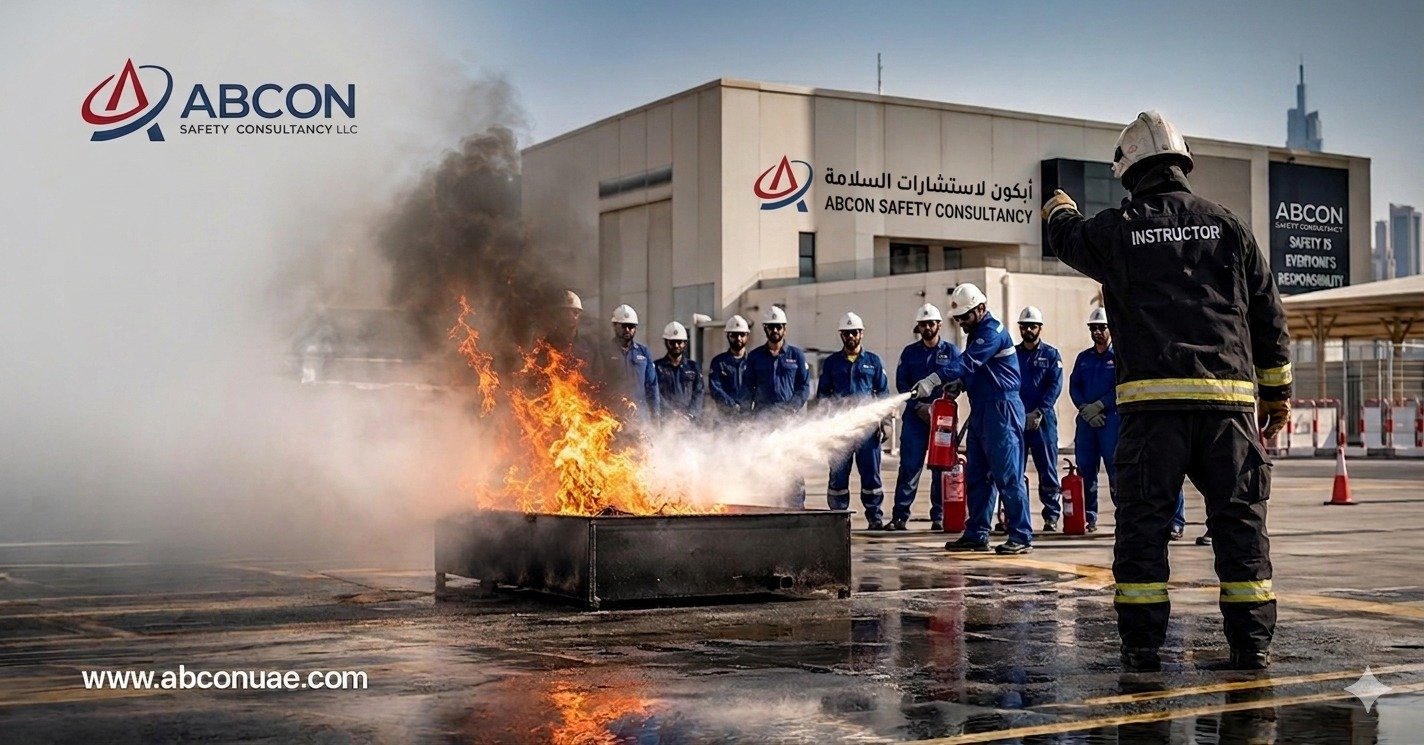
The practical component is what separates genuine fire fighting training from a theoretical presentation. Trainees use real extinguishers on controlled live fires, practice evacuation procedures under timed conditions, and develop the muscle memory that determines how a person actually responds when a real emergency happens not how they think they will respond.
Advanced courses increasingly incorporate Virtual Reality (VR) fire training immersive simulations that allow trainees to experience realistic fire scenarios including high-rise evacuations, chemical fires, and multi-casualty incidents in a safe, repeatable environment. VR offers immersive, risk-free environments for trainees to experience realistic fire scenarios that enhance situational awareness and response confidence.
DCD Approval vs. KHDA Approval — What's the Difference?
This is one of the most common sources of confusion for HR managers sourcing fire safety training in Dubai.
DCD approval means the training programme has been assessed and formally recognised by Dubai Civil Defence. A DCD approved fire fighting certificate is the standard accepted by Dubai regulators for workplace compliance purposes it is what your site will be checked against during a DCD inspection.
KHDA approval means the training provider has been approved by the Knowledge and Human Development Authority to operate as a training provider in Dubai. It is a provider-level registration, not course content approval.
For fire safety compliance in Dubai, the critical designation is DCD approved. Always ask your training provider for their DCD approval reference before booking not just KHDA registration.
For Abu Dhabi, the equivalent authority is Abu Dhabi Civil Defence (ADCD). Training delivered in Abu Dhabi should be ADCD approved or aligned with ADCD requirements. Fire Fighting and Fire Warden Training is approved and aligned with Civil Defence, ADNOC, ADOSH, QCC, MOIAT, and international safety standards.
How Often Does Fire Fighting Training Need to Be Renewed?
Upon successful completion of the course, participants receive a certification that is typically valid for two years. Recertification through refresher training courses is often required to maintain compliance and keep skills up to date.
In practice, most UAE employers schedule annual refresher training to ensure their teams' skills remain sharp and their documentation is always current ahead of Civil Defence inspections. Certificate validity alone is not the only metric DCD inspectors also assess whether emergency drills have been conducted and documented regularly.
The Real Cost of Not Training Your Team
The financial argument for fire fighting training in the UAE is straightforward. A half-day Level 1 course costs between AED 150 and AED 400 per person. A Level 2 fire warden course costs between AED 400 and AED 800 per person. An advanced Level 3 programme runs AED 700 to AED 2,000.
Compare those figures to the cost of a single DCD enforcement action which can include business shutdowns, licence complications, and fines and the return on investment is immediate.
But the real cost of an undertrained workforce is not measured in fines. It is measured in the outcome of those critical first minutes when a fire starts before Civil Defence arrives. An employee who has completed genuine, hands-on fire fighting training responds effectively. An untrained employee freezes, makes the wrong decision, or does nothing at all.
In a high-rise, warehouse, or industrial facility in the UAE, those decisions determine outcomes.
Frequently Asked Questions
Is fire fighting training legally required in the UAE?
Yes. Fire Fighting and Fire Warden Training has become essential for compliance, workplace safety, and emergency preparedness. With increasing safety regulations and workplace risks, fire fighting and fire warden training in UAE is no longer optional it is a legal and operational necessity. DCD and ADCD actively inspect businesses and require documented evidence of trained staff.
What is the difference between fire fighting training and fire warden training?
Fire fighting training (Level 1) covers basic fire awareness and extinguisher use for all employees. Fire warden training (Level 2) is specifically for designated wardens who must lead evacuations and coordinate emergency response. Both are required for different members of your workforce.
How long is a DCD approved fire fighting certificate valid in Dubai?
Certification is typically valid for two years. Recertification through refresher training is often required to maintain compliance. Many employers schedule annual refreshers to keep documentation current.
Can fire fighting training be delivered at our site in Dubai?
Yes. ABCON Safety Consultancy provides on-site fire fighting training across Dubai and Abu Dhabi for groups of any size. Contact us at +971 2517 5773 to arrange.
What approval should I look for when choosing a fire fighting training provider in Dubai?
Look for DCD (Dubai Civil Defence) approval for Dubai-based compliance. For Abu Dhabi, confirm ADCD alignment. Also check whether the provider is TRAKHEES approved if your facility operates in a free zone. ABCON holds DCD and TRAKHEES approval — view our full accreditations here.
Which industries require fire warden training in Dubai?
Employers in construction, facilities management, logistics, hospitality, and oil and gas require candidates who hold recognised fire safety certificates. In practice, any business with permanent premises and employees in Dubai is required by DCD to maintain trained fire wardens on site.
How much does fire fighting training cost in the UAE?
Level 1 Basic Fire Safety costs AED 150–400 per person. Level 2 Fire Warden Training costs AED 400–800 per person. Level 3 Advanced Fire Fighting costs AED 700–2,000 per person. ABCON offers competitive group rates — contact us for a tailored quote for your team.