'/%3E%3Cpath d='M30 0v30M0 15h60' stroke='%23FFF' stroke-width='10'/%3E%3Cpath d='M30 0v30M0 15h60' stroke='%23C8102E' stroke-width='6'/%3E%3C/svg%3E)
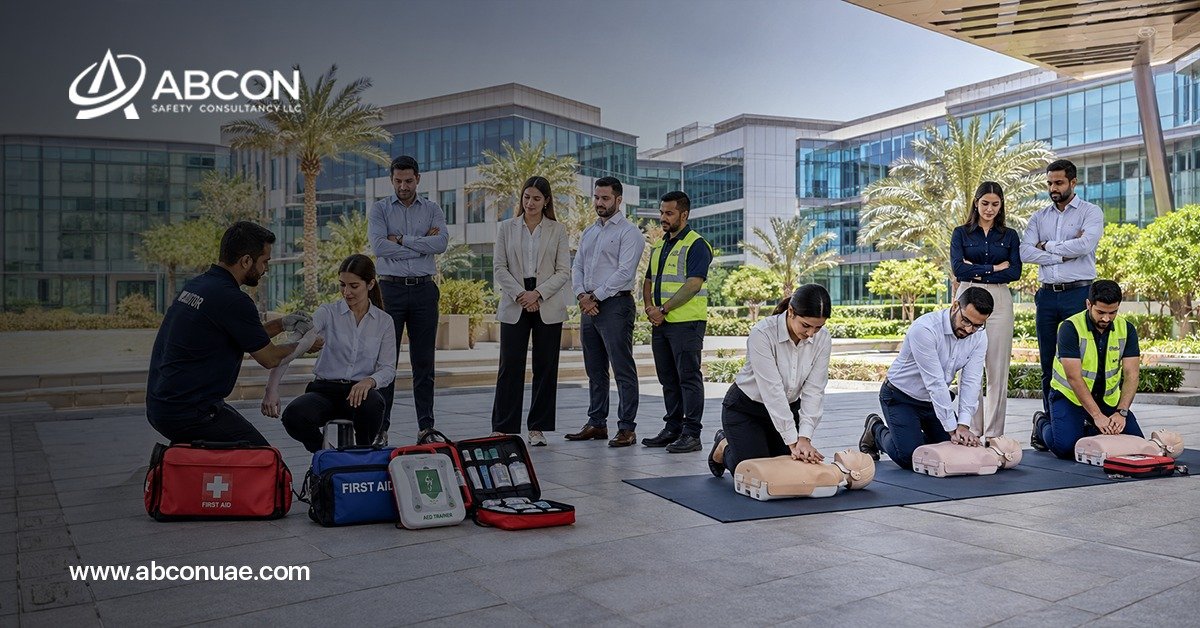
First Aid vs CPR Training: Key Differences & Which One Your UAE Team Needs
Explains the difference between first aid and CPR training for UAE workplaces — first aid is broad (covers wounds, burns, fractures, plus CPR as one module), while CPR is narrow (cardiac/breathing emergencies and AED use only). Helps businesses decide which course(s) they need based on risk profile and DCAS/Trakhees compliance, with a comparison table, checklist, 5 FAQs, and a consultation CTA.
Explains the difference between first aid and CPR training for UAE workplaces — first aid is broad (covers wounds, burns, fractures, plus CPR as one module), while CPR is narrow (cardiac/breathing emergencies and AED use only). Helps businesses decide which course(s) they need based on risk profile and DCAS/Trakhees compliance, with a comparison table, checklist, 5 FAQs, and a consultation CTA.
Introduction
If you're arranging safety training for your team in Dubai or Abu Dhabi, you've likely run into the same question HR and safety officers ask every year: do we need first aid training, CPR training, or both?
The two terms get used interchangeably in casual conversation, but they are not the same course, they don't cover the same skills, and UAE regulators don't treat them as interchangeable either. Booking the wrong one or assuming a CPR-only certificate satisfies your full workplace safety obligation can leave your team under-prepared and your business out of compliance with Dubai Corporation for Ambulance Services (DCAS) requirements.
This guide breaks down exactly what separates first aid training from CPR training, what each certificate actually covers, and how to decide which one (or both) your UAE workplace needs.
What Is First Aid Training?
First aid training is a broad course that prepares participants to respond to a wide range of medical emergencies — not just cardiac events. A standard first aid course typically covers:
Primary survey and casualty assessment (DRABC: Danger, Response, Airway, Breathing, Circulation)
Wound care, bleeding control, and bandaging
Burns, fractures, and sprains
Choking response
Shock management
Basic CPR as one module within the wider course
In the UAE, a DCAS-approved first aid course is the standard requirement for workplaces across construction, hospitality, education, and corporate offices, since it prepares a first aider to handle the full spectrum of incidents likely to occur on-site — not just cardiac arrest.
What Is CPR Training?
CPR (Cardiopulmonary Resuscitation) training is a focused, shorter course centered entirely on one scenario: what to do when someone's heart stops beating or they stop breathing. A CPR course covers:
Chest compressions (adult, child, and infant techniques)
Rescue breaths and airway management
AED (Automated External Defibrillator) operation
Recognizing cardiac arrest versus other medical emergencies
CPR training is deliberately narrow. It doesn't cover wound care, burns, fractures, or general casualty management — it exists purely to build competence and confidence in the highest-stakes, most time-critical emergency a workplace can face.
First Aid vs CPR: The Key Differences at a Glance
Factor | First Aid Training | CPR Training |
|---|---|---|
Scope | Broad — covers multiple emergency types | Narrow — cardiac/breathing emergencies only |
Duration | Typically 1–2 full days | Often a half-day or standalone module |
Includes CPR? | Yes, as one module | Yes, as the entire focus |
Best for | General workplace safety compliance | High-risk environments needing rapid cardiac response readiness |
DCAS relevance | Meets broader workplace first-aider requirements | Often required alongside AED placement in specific high-risk roles |
The core distinction is simple: CPR is a subset of first aid, not a replacement for it. Every first aid course includes CPR instruction, but a standalone CPR course does not cover the rest of first aid.
Which One Does Your UAE Team Actually Need?
Choose First Aid Training If:
You need a general workplace first-aider to meet Dubai Municipality, Trakhees, or free zone compliance requirements
Your team faces a variety of risks — cuts, burns, falls, fractures not just cardiac events (common in construction, hospitality, warehousing, retail)
You're designating one or more employees as your site's official first aid officer
Choose CPR Training If:
You already have first-aid-certified staff and want to add focused, rapid-response cardiac training
Your environment has elevated cardiac risk factors — gyms, spas, high-exertion industrial sites, or facilities with an aging workforce
You're installing AEDs on-site and need staff specifically trained to operate them
Choose Both If:
You operate in construction, oil & gas, manufacturing, hospitality, or any high-risk sector where DCAS or your regulatory authority expects a fully equipped first aid response, including cardiac emergencies
You want your safety officers cross-trained so no single point of failure exists during an incident
For most UAE businesses, a combined first aid and CPR course is the more practical and cost-effective choice, since CPR is already embedded in a comprehensive first aid program you're not paying for two separate certifications to cover overlapping ground.
UAE Regulatory Considerations
Before booking either course, confirm the following:
DCAS approval: Any first aid or CPR provider operating in Dubai should be verifiable through the DCAS training provider registry
Trakhees, KHDA, or free zone requirements: Some free zones mandate a minimum ratio of certified first aiders per number of employees on-site
Renewal timelines: Most first aid and CPR certifications in the UAE require renewal every 1–2 years to remain valid for compliance purposes
AED-specific training: If your site has an AED installed, confirm your CPR course includes hands-on AED operation, not just theoretical coverage
Best Practices Checklist Before You Book
Confirm whether your workplace risk profile needs broad first aid coverage, focused CPR, or both
Verify the provider is DCAS-approved (and Trakhees/KHDA-recognized if relevant to your zone)
Check if AED training is included if your site has a defibrillator installed
Confirm the required first-aider-to-employee ratio for your industry
Ask about renewal cycles and schedule refreshers in advance
Choose hands-on, scenario-based instruction over slide-only theory sessions
Frequently Asked Questions
1. Is CPR training enough to satisfy UAE workplace safety requirements?
Usually not on its own. Most UAE regulatory bodies, including Dubai Municipality and free zone authorities, expect a designated first aider to hold a full first aid certification, which already includes CPR. Standalone CPR training is typically an add-on for high-risk or specialized roles, not a substitute for full first aid coverage.
2. How long does first aid or CPR certification last in the UAE?
Most certifications are valid for 1–2 years, after which a refresher course is required to maintain compliance. Always confirm the exact validity period with your training provider, as it can vary by awarding body.
3. Can one employee complete both first aid and CPR training together?
Yes in fact, this is the most common and cost-effective approach. Combined courses cover general first aid skills alongside dedicated CPR and AED modules in a single session, avoiding duplicate training time.
4. Do all UAE workplaces need a certified first aider on-site?
Most commercial workplaces in Dubai and Abu Dhabi are required to have at least one trained first aider available during working hours, with the exact ratio depending on employee count and industry risk level. Check with Dubai Municipality, Trakhees, or your free zone authority for your specific requirement.
5. Is online first aid or CPR training valid in the UAE?
Practical skills like chest compressions and AED use require hands-on assessment, so most DCAS-approved courses use a blended format online theory combined with an in-person practical session rather than a fully online course.
Final Thoughts: Match the Training to the Risk, Not Just the Requirement
The real question isn't "first aid or CPR" it's what your workplace is actually likely to face. A construction site needs broad first aid coverage for cuts, falls, and fractures as much as cardiac readiness. A high-exertion facility with an AED on-site needs staff who can act on cardiac arrest within minutes. Most UAE workplaces are better served by a combined course that builds both skill sets at once, rather than choosing one over the other.
Not sure which course fits your team's risk profile? Get in touch for a free consultation we'll help you determine the right first aid and CPR training plan based on your industry, headcount, and DCAS compliance requirements, so your team is ready before an emergency happens, not after.