'/%3E%3Cpath d='M30 0v30M0 15h60' stroke='%23FFF' stroke-width='10'/%3E%3Cpath d='M30 0v30M0 15h60' stroke='%23C8102E' stroke-width='6'/%3E%3C/svg%3E)

ISO 45001 Explained: How HSE Training Supports Your Company's Certification
Explains what ISO 45001 requires and why HSE training is central to certification — auditors test employee competence, not just paperwork. Covers foundational, role-specific, management, and refresher training types, common audit findings tied to training gaps, a readiness checklist, 5 FAQs, and a CTA to build an audit-ready training program.
Explains what ISO 45001 requires and why HSE training is central to certification — auditors test employee competence, not just paperwork. Covers foundational, role-specific, management, and refresher training types, common audit findings tied to training gaps, a readiness checklist, 5 FAQs, and a CTA to build an audit-ready training program.
Introduction
If your company is working toward ISO 45001 certification in the UAE, you've probably already discovered that it's not a paperwork exercise — it's an audit of whether your organization can actually demonstrate a functioning occupational health and safety management system, in practice, not just on paper.
One of the most common reasons UAE companies fail or delay their ISO 45001 audit isn't a missing policy document — it's a gap between what the documentation says and what employees can actually demonstrate when an auditor asks them a direct question. That gap is almost always a training gap.
This guide explains what ISO 45001 actually requires, why HSE training sits at the center of certification success, and how to structure your training program so your next audit goes smoothly instead of surfacing findings you have to scramble to close.
What Is ISO 45001?
ISO 45001 is the international standard for occupational health and safety (OH&S) management systems, published by the International Organization for Standardization. It replaced the older OHSAS 18001 standard and is built around the same high-level structure used across other ISO management system standards (like ISO 9001 and ISO 14001), making integrated management systems easier to implement.
At its core, ISO 45001 requires an organization to:
Identify hazards and assess occupational health and safety risks proactively, not reactively
Establish clear roles, responsibilities, and worker participation in safety decision-making
Implement controls to eliminate or reduce risk
Monitor, audit, and continually improve the management system
Ensure competence — meaning employees are demonstrably trained, not just informed
That last point is where HSE training stops being a "nice to have" and becomes a certification requirement.
Why HSE Training Is Central to ISO 45001, Not Optional
ISO 45001 explicitly requires organizations to determine the necessary competence of workers whose work affects OH&S performance, and to ensure that competence through education, training, or experience with documented evidence available for audit.
In practical terms, this means:
1. Auditors Test Competence, Not Just Documentation
An ISO 45001 auditor doesn't just review your training matrix they interview employees on the floor. If a worker can't explain the hazards in their own role, the emergency procedure for their area, or how to report a near-miss, that's a nonconformity, regardless of what your training records say.
2. Risk Assessments Are Only as Good as the People Executing Them
ISO 45001 requires ongoing hazard identification and risk assessment a process that depends entirely on trained personnel recognizing hazards correctly in the first place. Untrained staff systematically under-report risk, which undermines the entire management system the standard is built on.
3. Worker Participation Is a Named Requirement
The standard explicitly requires consultation and participation of workers in OH&S matters. Employees can't meaningfully participate in safety decisions they don't understand structured HSE training is what makes genuine participation possible rather than symbolic.
4. Legal and Regulatory Compliance Ties Back to Training
ISO 45001 requires organizations to identify and comply with applicable legal requirements in the UAE, this includes MOHRE labor safety regulations, OSHAD (Abu Dhabi), Dubai Municipality, and Civil Defence requirements. HSE training is the mechanism that translates those legal obligations into practical, demonstrable competence on-site.
Which HSE Training Supports ISO 45001 Certification?
Foundational Training (Organization-Wide)
General HSE awareness and induction training for all employees
Emergency response and evacuation procedures
Incident reporting and near-miss reporting protocols
Role-Specific Training
Risk assessment and hazard identification training for supervisors and safety officers
Permit-to-work systems training for high-risk activities (hot work, confined space, working at height)
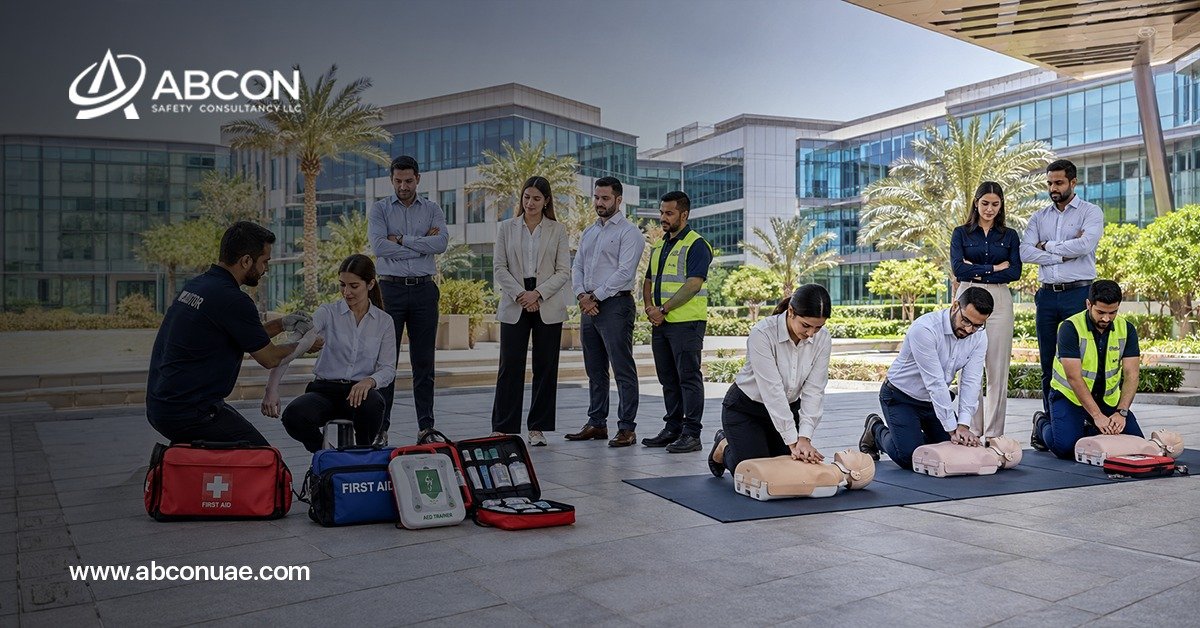
First aid and emergency response training aligned with DCAS requirements
Management-Level Training
Internal auditor training for ISO 45001, enabling your team to conduct effective internal audits between external surveillance visits
Leadership and worker participation training, addressing the standard's explicit requirement for management commitment and employee involvement
Ongoing/Refresher Training
Scheduled refresher courses aligned with your management system's continual improvement cycle
Updated training whenever processes, equipment, or legal requirements change a gap here is a common audit finding
A well-structured training matrix maps each role in your organization to the specific competencies ISO 45001 requires for that position, with documented completion dates and renewal cycles this matrix itself is typically one of the first documents an auditor will request.
Common ISO 45001 Audit Findings Related to Training Gaps
Training records exist, but employees cannot demonstrate the knowledge during interview
No evidence of training effectiveness evaluation (attendance isn't the same as competence)
Refresher training cycles are undefined or inconsistently followed
New employees not inducted before starting work on-site
Training content not updated after a process, equipment, or regulatory change
Each of these is preventable with a properly designed and consistently delivered HSE training program — which is exactly why experienced ISO 45001 consultants treat training as a certification workstream, not an HR afterthought.
Best Practices Checklist for ISO 45001-Aligned HSE Training
Build a training matrix mapping every role to required competencies
Ensure training providers are accredited and recognized by relevant UAE authorities
Document not just attendance, but competence verification (assessments, practical demonstrations)
Schedule refresher training on a defined, tracked cycle
Train internal auditors to catch gaps before an external audit does
Update training content whenever processes, equipment, or legal requirements change
Involve workers directly in hazard identification and safety discussions, not just top-down instruction
Frequently Asked Questions
1. Is HSE training mandatory for ISO 45001 certification?
Yes. ISO 45001 explicitly requires organizations to ensure worker competence through training, education, or experience, with documented evidence. Certification bodies will not issue or maintain certification without demonstrable training records and competence.
2. How often does ISO 45001-related HSE training need to be refreshed?
This depends on role and risk level, but most organizations schedule refresher training annually for general awareness and more frequently for high-risk role-specific training (permit-to-work, confined space, working at height).
3. Can internal training satisfy ISO 45001 competence requirements, or does it need to be external?
Both are acceptable as long as competence can be demonstrated and documented. However, external training from accredited providers often carries more weight during audits, particularly for specialized or high-risk competencies.
4. What happens if a training gap is found during an ISO 45001 audit?
It's typically raised as a nonconformity, which the organization must address with a corrective action plan within a defined timeframe. Repeated or unresolved training-related nonconformities can delay or jeopardize certification.
5. Does ISO 45001 require a specific number of training hours?
No — the standard doesn't mandate specific hour counts. It requires that competence is demonstrable and appropriate to each role's risk exposure, which is why a role-based training matrix matters more than a generic hours quota.
Final Thoughts: Training Is the Bridge Between Policy and Practice
ISO 45001 certification isn't won on the strength of your policy documents — it's won on whether your people can demonstrate, in real time, that the system actually works. HSE training is the mechanism that turns a written safety policy into practical, auditable competence across your organization. Companies that treat training as a continuous, structured program not a one-time checkbox are the ones that pass audits smoothly and stay certified.
Preparing for ISO 45001 certification or your next surveillance audit? Get in touch for a free consultation on building an HSE training program mapped directly to ISO 45001 requirements so your team is audit-ready, not audit-anxious.